
Men and pelvic health: the conversation nobody’s having
When people talk about pelvic floor problems, they’re usually talking about women. Leaking after childbirth. Prolapse after menopause. The assumption is so ingrained that most men have never once considered that they even have a pelvic floor, let alone that it might be de-toned or weakened.
What is the male pelvic floor?
The pelvic floor is a group of muscles that sits at the base of the pelvis in everyone – men and women alike. In men, these muscles support the bladder and bowel, play a role in erectile function and ejaculation, and help control urination. A healthy pelvic floor contributes to good bladder control, comfortable bowel function and a sex life that works well.
When those muscles weaken, stop functioning properly, or are damaged – the consequences are just as significant for men as they are for women. They’re just far less talked about.
When does the male pelvic floor become a problem?
There are several points in a man’s life when pelvic floor weakness can become an issue.
The most significant is prostate surgery. Prostatectomy – the surgical removal of the prostate gland, most commonly performed for prostate cancer – frequently causes urinary incontinence and erectile difficulties as a direct result of the disruption to the pelvic floor muscles surrounding the prostate. For many men, this is devastating. They come through cancer treatment only to find that a different set of problems now defines their daily life.
Age is another factor. Just as muscle mass and strength decline generally as men get older, so does pelvic floor function.
The silence around male incontinence
Here’s something worth sitting with: surveys consistently show that men wait significantly longer than women before seeking help for bladder problems. The average is several years. In that time, they quietly adjust; drinking less, planning routes around toilet locations, avoiding situations where leaking might be noticed.
Male incontinence sits in a space where embarrassment, masculinity and a general reluctance to discuss anything below the belt collide. Add to that the fact that most of the available information and marketing around pelvic floor treatment is aimed at women, and it’s easy to see why men don’t seek help.
They should. The treatment works just as well for them.
How BetterPelvi works for men
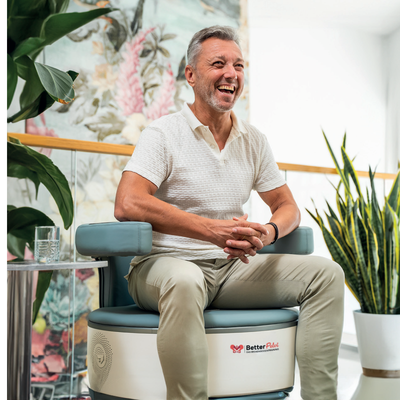
The BetterPelvi chair uses rPMS technology to generate targeted contractions across all three layers of the pelvic floor simultaneously. It’s the same treatment that helps women recover bladder control and pelvic strength – and it works in exactly the same way for men.
You sit fully clothed in the BetterPelvi chair for 28 minutes. Nothing is invasive, nothing is uncomfortable, and you don’t need to do anything. The technology does all the work.
BetterPelvi has been tried and tested over several years in European hospitals and clinics, where it’s well established as part of post-surgical rehabilitation, and now this revolutionary technology is available at Blakemere Village, Cheshire.
Results vary depending on the extent of any nerve or muscle damage, but many men notice meaningful improvement in urinary control within their course of treatment. For men experiencing age-related bladder weakness or urgency, rather than post-surgical recovery, the results are often faster and more noticeable still.
What to expect when you come in
We’re aware that walking through the door of a pelvic health clinic takes a particular kind of courage for a man. Perhaps even more than it does for a woman, given how little normalisation exists around this topic for men.
So let us be clear: there is nothing about your situation that will surprise us, and nothing that will be handled with anything other than complete discretion and professionalism. The consultation is a conversation – we’ll ask about your symptoms, your history, and what you’re hoping to achieve, and we’ll be honest with you about what BetterPelvi can and can’t do for your specific situation.
The consultation and taster session takes around 60 minutes. You stay fully clothed throughout.
If you’ve been managing bladder or pelvic symptoms in silence, whether for months or years, a BetterPelvi consultation at Signature Health might just be the conversation that changes things.